

The Architecture of Organizational Survivability
Whatever it is, the way you tell your story online can make all the difference.
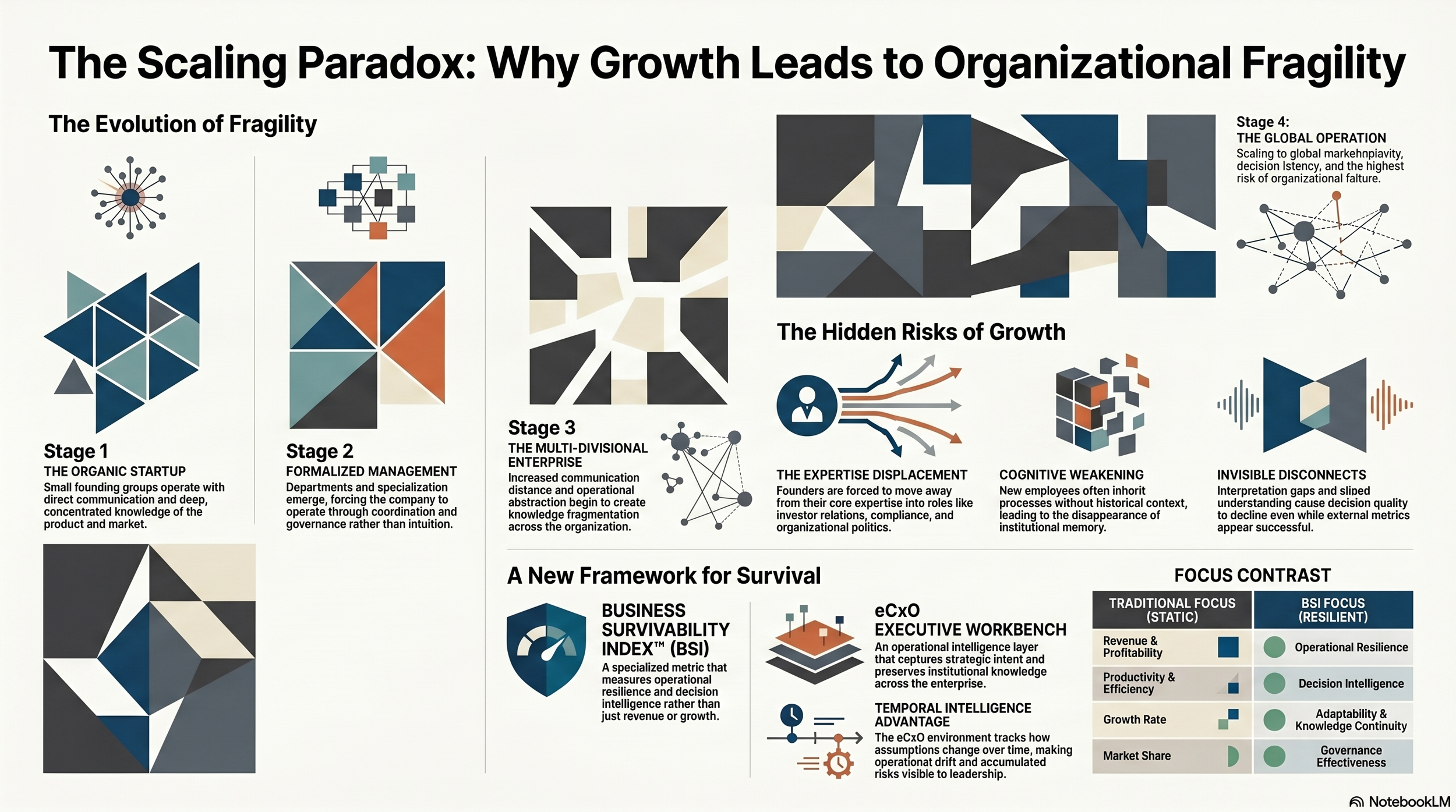
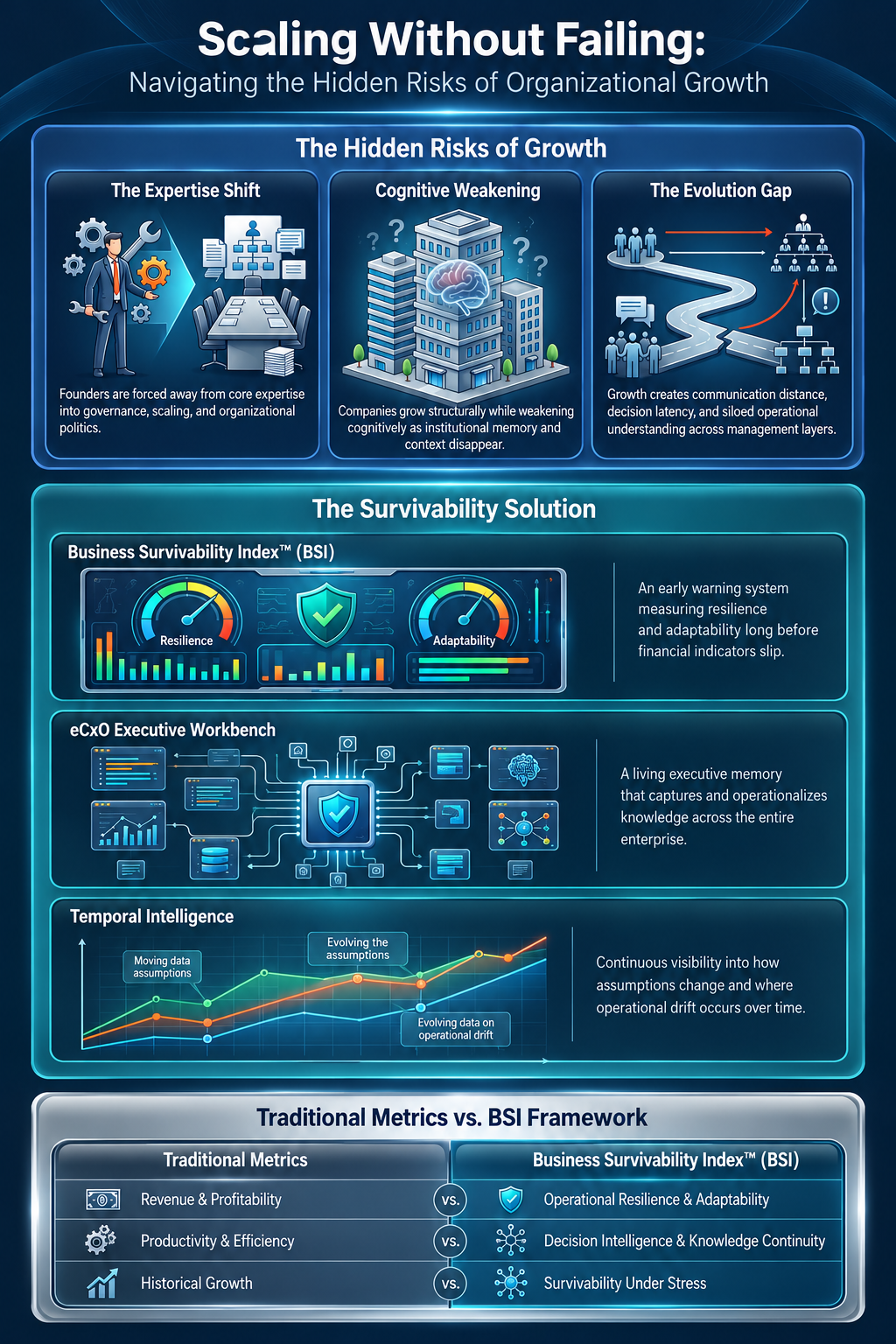
As a company expands from a small founding group into a complex global entity, it faces a high risk of cognitive decline and organizational fragility. This transition often causes founders to drift away from their core expertise while institutional memory fades and management layers create dangerous knowledge silos.
To combat this, the Business Survivability Index™ serves as a vital early warning system by measuring operational resilience and adaptability beyond simple financial metrics. Simultaneously, the eCxO Executive Workbench acts as a living intelligence layer that captures strategic intent and preserves decision-making context across the enterprise. Together, these tools mitigate the risks of growth-driven failure by ensuring that critical insights are not lost to time or complexity. By maintaining operational visibility through these systems, leaders can navigate market shifts and structural changes without losing their strategic coherence.
How Does Organizational Evolution Create Hidden Risks as Companies Grow?
The Transition from Intuition to Coordination
In their early stages, organizations operate organically; founders possess deep, concentrated knowledge and make fast decisions based on shared intuition. As the company scales, it develops layers of management, specialized departments, and formalized processes. This structural growth often leads to a "cognitive weakening" of the organization: while the company grows physically and structurally, its collective understanding of why things are done actually diminishes.
Interpretation Gaps and Decision Distortion
As management layers increase, they introduce "invisible disconnects" that compromise the health of the business. These risks include:
Interpretation Gaps: Information is filtered and misinterpreted as it moves through layers.
Reporting Abstraction: Executives receive high-level data that lacks the nuance of ground-level reality.
Siloed Understanding: Specialized departments lose sight of the broader strategic coherence, leading to decisions that may benefit a department but harm the overall organization.
Loss of Context and Rationale
A significant hidden risk is the arrival of new employees who inherit "systems without context" and "processes without rationale". Because the original institutional memory is trapped within founders or early managers who have moved into different roles, new staff often execute tasks without a historical understanding of the original strategic intent.
The Danger of Static Assumptions
Growth often coincides with entering new markets or adopting new technologies like AI. The hidden risk here is that the foundational assumptions that made the company successful may no longer apply. Without visibility into how the organization has evolved over time—what the sources call "temporal awareness"—executives may fail to see where "operational drift" is occurring until it is too late.
Gradual vs. Sudden Failure
The sources emphasize that organizations rarely fail suddenly; instead, they fail gradually through accumulated operational friction and decision degradation. A company may appear successful externally while its internal decision quality and governance are actively eroding.
To mitigate these risks, the sources suggest using tools like the Business Survivability Index™ (BSI) and the eCxO Executive Workbench. These tools are designed to capture and operationalize institutional knowledge, making "invisible disconnects" visible before they lead to organizational failure